


The other day, I didn’t feel like writing something. I found myself cataloguing all the reasons why now wasn’t the time: a slight headache, the sense of being slightly under-caffeinated, an issue nagging at me about how I’d organized my notes…As I went through this litany of objections, my thoughts turned to books and other sources of advice I might consult for solutions.
Then, in a flash, I realized (again) that solution-seeking is my worst habit. There’s nothing wrong with “sharpening the saw,” as Stephen Covey put it, but the truth is that I only find myself reaching for the whetstone when it’s time to write. At no point have I ever stood up in the middle of a movie to re-organize my notes or read a book on productivity.
Rather than push through the discomfort that precedes every writing session, I seek this morally acceptable form of escape. Playing video games and watching YouTube videos are obviously forms of procrastination, but when something feels productive, it’s easy to fool myself.
This train of thought lead to Fight Club.
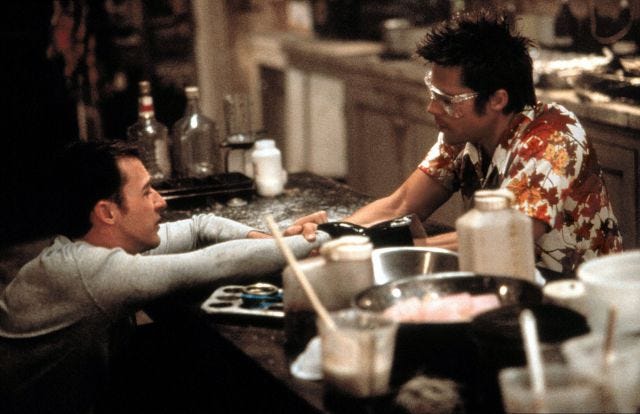
Tyler Durden subjects Ed Norton’s narrator to a chemical burn with lye, and refuses to neutralize it with a splash of vinegar until Norton stops struggling and accepts the discomfort.
The narrator tries to escape the pain through fantasy and visualization, to mentally check out, but Tyler keeps yanking him back to now: “This is the greatest moment of your life.” Only once the narrator stops fighting and inhabits the discomfort does Tyler deliver relief.
Weirdly, we see the same thing happen in Dune.

The Reverend Mother forces the protagonist, Paul Atreides, to put his hand in a special box that causes intense pain. There’s no physical damage. Just pain. Holding a poisoned needle at Paul’s neck, she explains the nature of the test: if you remove your hand to escape the pain, you die. The only way through the discomfort is by accepting it. Hurt or suffer: your call.
That’s how writing works. You earn relief by accepting the pain. There is no other way. No book, course, piece of software, or AI agent will make it easier. Only doing the work.
A third example struck me, the perfect complement: The Story About Ping, a children’s classic I read to my kids many times when they were younger.
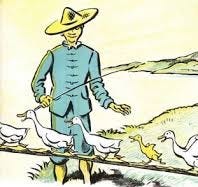
On the Yangtze river, the last duck to return to the boat gets a whack. When Ping realizes he’s pulling up the rear one evening, he swims away rather than facing his punishment. As a result, he encounters one misfortune after another.
Crucially, everything that goes wrong makes no difference in the end. That spanking is always waiting for him. It’s the price of moving forward. When Ping finally find his boat again, he happily endures his punishment. His only regret is trying to avoid it in the first place.
Think of the days, weeks, and months you spent procrastinating on a piece of writing that ended up taking an hour or two to complete. Given a time machine, wouldn’t you go back and just write the damn thing the first time you were supposed to do it? Better to hurt than suffer.
It depends. I wrote half a dozen books while procrastinating over a single book for about 15 years. As it turned out, the procrastination was well worth it. Instead of trying to push the ideas down someone's throat, I was able to use a lot of misdirection, and as a result, the reader changes their mind without any force on my part.